

Most lollipop manufacturing problems trace back to a few causes: moisture, temperature, or an uneven candy rope. Here are the problems we hear about most from plants, and where to look first.
- Sticky or cloudy candy usually means a recipe or moisture issue
- Uneven lollipops almost always start at the rope sizer
- Cooling time prevents cracks and wrapper sticking
Lollipop manufacturing problems: sticky lollipops
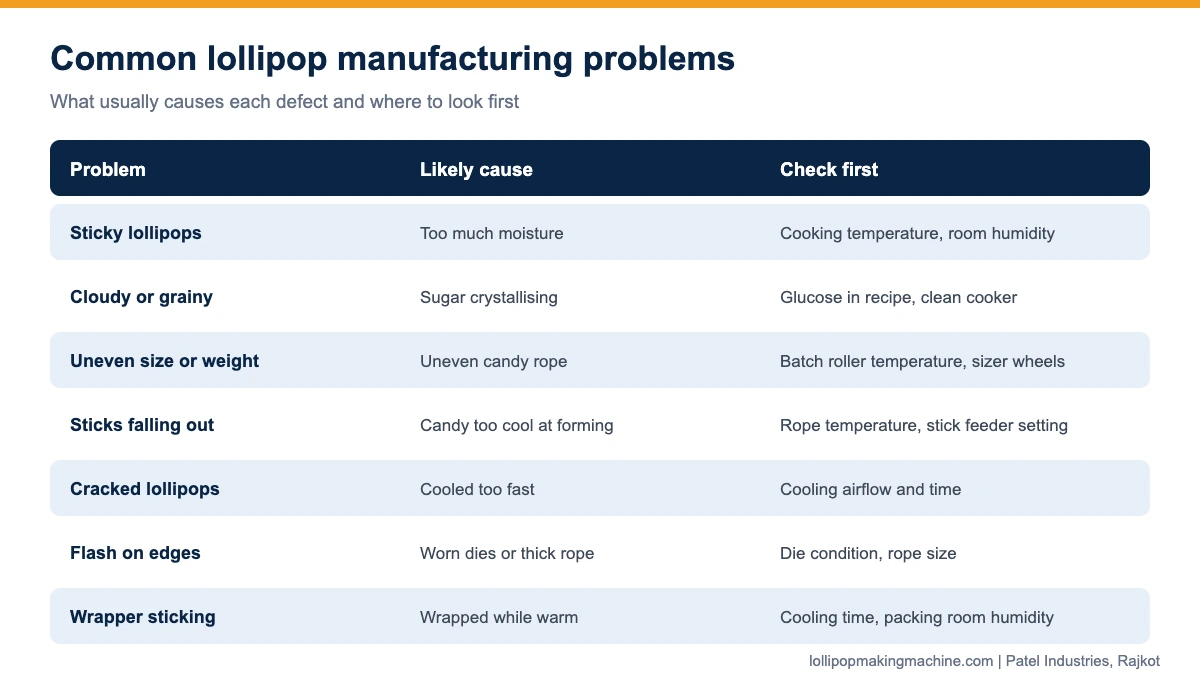
Usually the candy has too much moisture. Either it wasn’t cooked long enough, or it picked up moisture from humid air after forming. Check the cooking temperature, keep the forming and packing room dry, and wrap lollipops as soon as they are hard. A vacuum batch cooker helps by removing more water at a lower temperature.
Cloudy or grainy candy
Sugar is crystallising. This happens when the recipe has too little glucose, the mass is overworked while cooling, or sugar crystals fall back into the batch from the cooker walls. Check the recipe and keep the cooker clean.
Uneven size or weight
Almost always a rope problem. If the rope from the batch roller and rope sizer varies in thickness, the lollipops vary too. Keep the batch roller at the right temperature and check the sizer wheels for wear. Worn dies can also cause it.
Sticks falling out
The candy was too cool when the stick went in, or the stick went in too shallow. Check the rope temperature at the forming head and the stick feeder setting.
Cracked lollipops
Lollipops cooled too fast, or were handled while still soft. Check the airflow on the cooling conveyor and give them enough time to harden before wrapping.
Flash or rough edges
Extra candy around the ball usually means worn or damaged dies, or a rope that is too thick for the die. Check the dies and adjust the rope size.
Wrapper sticking
Lollipops were wrapped while still warm or the packing room is humid. Let them cool fully and keep the room dry. In humid seasons a dehumidifier in the packing room often pays for itself in fewer rejects and returns. Wrapping film also matters: check that it suits hard candy and is stored away from heat, so it runs smoothly through the wrapping machine.
Preventing problems before they start
Most defects are cheaper to prevent than to fix. Keep a simple record for each batch: cooking temperature, time, room humidity and any changes to the recipe. When a problem appears, the record shows what changed. Clean the cooker, batch roller and dies every shift, and check the rope sizer wheels and dies each week for wear. Train every operator to spot early signs such as a slightly sticky surface or a small change in lollipop size, and to report them before they turn into a full batch of rejects.
Many of these issues come down to sugar chemistry. The hard candy article on Wikipedia explains how cooking temperature affects the finished candy.
Lollipop manufacturing problems: FAQ
What causes most lollipop manufacturing problems?
Moisture and temperature. Undercooked candy, humid rooms and wrapping too early cause most defects.
Why are my lollipops different sizes?
The candy rope is uneven or the dies are worn. Check the batch roller temperature and the rope sizer wheels first.
Can a vacuum cooker reduce lollipop manufacturing problems?
Yes. It removes more water at a lower temperature, which helps with sticky and cloudy candy.
If a problem keeps coming back, send us a photo of the lollipops and a short video of the line on WhatsApp at +91 99259 91005. It is often quicker to spot the cause on video.
Planning a lollipop line?
Tell us your lollipop size and target output. We will suggest the right machines.
Get a Quote on WhatsApp