

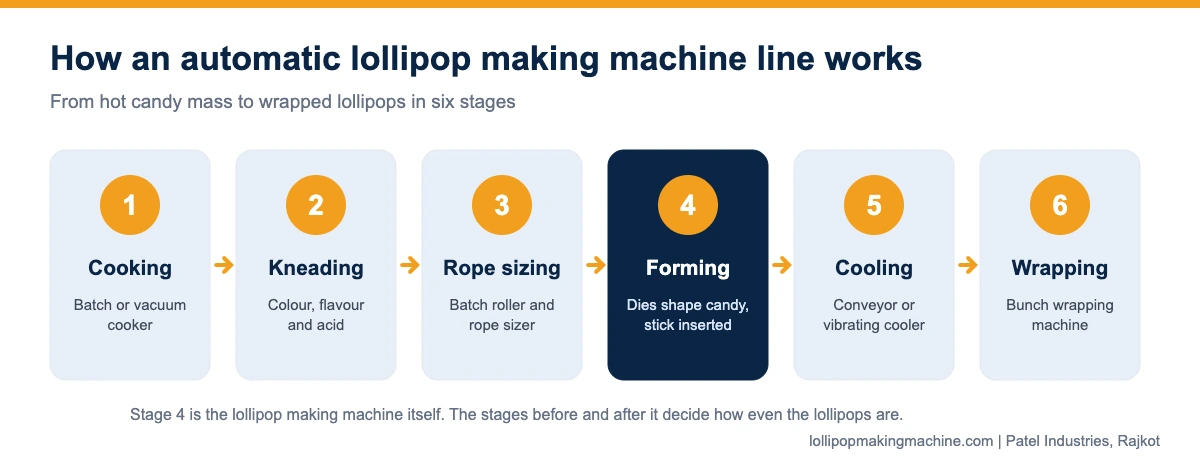
The lollipop making process has six stages, and an automatic lollipop making machine sits right in the middle of them. The machine takes a rope of warm candy, cuts it into equal pieces, presses each piece into shape and pushes a stick into it. A good machine does this hundreds of times a minute. What happens before and after it decides how good the lollipops are.
- Six stages: cooking, kneading, rope sizing, forming, cooling, wrapping
- An even candy rope is the key to even lollipops
- Output depends on die size and recipe, not just machine speed
1. Cooking the candy mass
Sugar, glucose and water are cooked in a batch cooker until most of the water is gone. A vacuum cooker does this at a lower temperature, which keeps the candy clearer and stops the sugar from browning. The cooked mass is poured onto a cooling table, where colour, flavour and acid are worked in by hand or with a kneading machine.
2. Batch roller and rope sizer
The kneaded mass goes into the batch roller. Its cone-shaped rollers turn the lump into a long, even cone and keep it warm so it stays soft. The rope sizer then pulls that cone through several pairs of wheels. Each pair makes the rope a little thinner until it matches the size of the forming die. If the rope is uneven here, the lollipops will be uneven later, so this step matters more than most buyers expect.
3. Forming and stick insertion
The sized rope runs straight into the forming head. Rotating dies cut the rope and press each piece into a ball or flat disc. At the same moment, the stick feeder pushes a stick into the soft candy. On an automatic machine the sticks come from a hopper, so nobody has to place them by hand. The die decides the shape and weight of the lollipop, which is why dies are cut to tight tolerances and can be changed for a new size.
4. Cooling
Freshly formed lollipops are still soft. They drop onto a cooling conveyor or vibrating cooler, where moving air hardens them in a few minutes. If they are packed too warm, they stick to the wrapper or lose their shape.
5. Wrapping and packing
Once hard, the lollipops go to a bunch wrapping machine or are packed by hand. A bunch wrapper twists film around the head of each lollipop and seals it, ready for the box.
What decides output in the lollipop making process
Output depends on the die size, the candy recipe and how well the rope sizer keeps up with the former. A small lollipop runs faster than a large one on the same machine. When you ask for a quote, give the lollipop weight or diameter and the number you want per hour, and the line can be sized to match.
Lollipops are a type of hard candy. For background on hard candy itself, see the hard candy article on Wikipedia.
Lollipop making process: FAQ
How long does the lollipop making process take?
Cooking a batch takes the longest. Once the mass is on the batch roller, forming, cooling and wrapping run continuously, so a line produces lollipops all shift long as long as the cooker keeps up.
Can the lollipop making process be fully automatic?
Forming, stick insertion, cooling and wrapping can all be automatic. Cooking and kneading usually need an operator to load batches and add colour and flavour.
What is the most important stage in the lollipop making process?
Rope sizing and forming. If the rope is uneven or the dies are worn, the lollipops vary in size and weight, whatever happens later.
Want to see which machines fit your plant? Send the machine name and your target output to Patel Industries on WhatsApp at +91 99259 91005.
Planning a lollipop line?
Tell us your lollipop size and target output. We will suggest the right machines.
Get a Quote on WhatsApp