

Flat vs ball lollipop is the first choice most new lollipop makers face. Both start from the same candy mass, but they need different forming machines. The answer comes down to what your customers buy and how much branding you want on the product.
- Ball lollipops suit high volume and low prices
- Flat lollipops carry logos and designs and sell for more
- One cooking line can feed both types of former
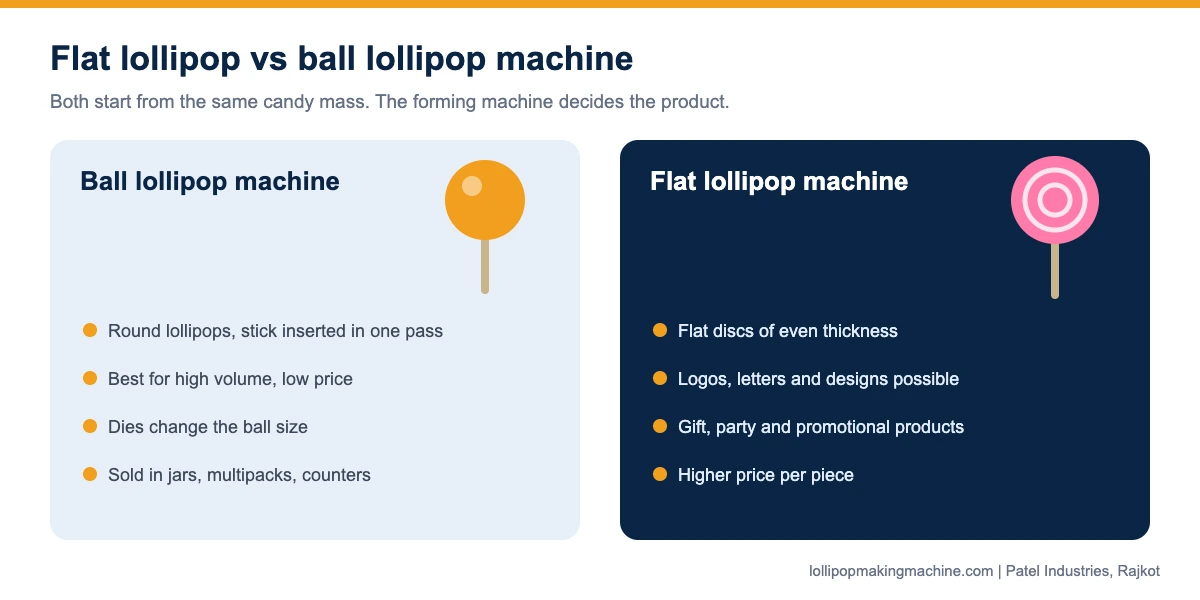
Flat vs ball lollipop: how the machines differ
A ball lollipop machine uses rotating dies that close around a piece of candy rope from several sides and press it into a sphere. The stick goes in while the candy is still soft. A flat lollipop machine presses the candy between two flat dies, so the result is a disc of even thickness. Flat dies can carry a raised design, a logo or letters, which is hard to do on a ball.
Which sells where
Ball lollipops are the everyday product. They sell in jars at shop counters, in multipacks and at low price points, so volume matters most. Flat lollipops are more often sold as gifts, party favours or branded promotions, where the look matters as much as the taste.
Output and running cost
Ball lollipop formers are built for long runs at high speed. If you plan to sell mainly through distributors at low margins, a high speed ball former usually makes more sense. Flat lollipop machines run slower but each piece can sell for more, especially with a custom design.
Dies and changeovers
Both machines use dies that set the size and shape. On a ball machine you change dies to move between diameters. On a flat machine you can also change the design. If you expect to make short runs for different customers, ask how long a die change takes and how many die sets you will need.
Can one line do both?
The cooker, kneader, batch roller and rope sizer of a lollipop production line can feed either type of former. Many plants start with one former and add the second later, using the same upstream machines.
Quick guide
- Choose a ball lollipop machine if you sell high volumes at low prices.
- Choose a flat lollipop machine if you want logos, shapes or gift products.
- Choose both if you have one cooking line and want to serve both markets.
Space, staff and changeovers
A ball former and a flat former take up similar floor space, but plan room around either one for die changes and cleaning. One trained operator can usually watch a forming machine, with others on cooling and packing. If you will make many short runs for different customers, ask how long a die change takes and keep the die sets you use most close to the machine. Short changeovers matter more for flat lollipops, where custom designs mean more frequent die swaps.
Whichever you choose, food-contact parts and production should follow your local food safety rules. In India that means FSSAI requirements.
Flat vs ball lollipop: FAQ
Which is cheaper, flat vs ball lollipop production?
Per piece, ball lollipops usually cost less to make because ball formers run faster. Flat lollipops can sell for more, so the margin may end up similar.
Can one forming machine make flat and ball lollipops?
No. Ball and flat lollipops need different forming heads and dies. The cooking and rope sizing machines before the former can be shared.
Which is better for a new business, flat vs ball lollipop?
Ball lollipops are the safer start for most new units because demand is steady. Flat lollipops suit businesses with gift, party or branded orders.
Not sure which fits your market? Tell us what you plan to sell and where, and we will suggest a setup. WhatsApp +91 99259 91005.
Planning a lollipop line?
Tell us your lollipop size and target output. We will suggest the right machines.
Get a Quote on WhatsApp